
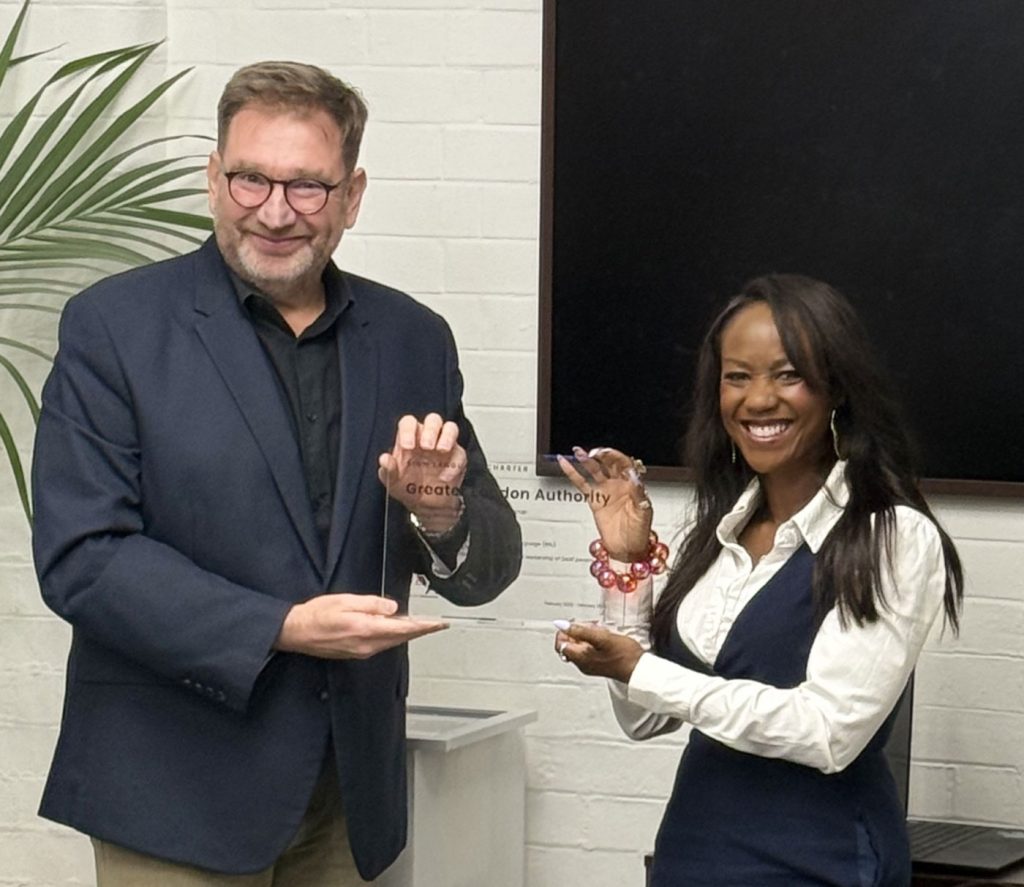
 British Deaf Association awards Sign Language Charter to Greater London Authority
The British Deaf Association has awarded its Sign Language Charter to the Greater London Authority (GLA), recognising the…
23 September 2026
British Deaf Association awards Sign Language Charter to Greater London Authority
The British Deaf Association has awarded its Sign Language Charter to the Greater London Authority (GLA), recognising the…
23 September 2026
What is BSL?
British Sign Language (BSL) is the preferred language of over 87,000 Deaf people in the UK for whom English may be a second or third language (A total of 151,000 individuals in the UK who can use BSL - this figure does not include professional BSL users, Interpreters, Translators, etc unless they use BSL at home).
Sign languages are fully functional and expressive languages; at the same time they differ profoundly from spoken languages. BSL is a visual-gestural language with a distinctive grammar using handshapes, facial expressions, gestures and body language to convey meaning.
The earliest recorded instance of gestural communication among Deaf people occurs in the Talmud. In his book, "Britain’s Deaf Heritage", Peter Jackson speculates that the presence of sign languages among Australian aborigines, Kalahari Bush People and North American Plains Indians suggests that the use of sign language goes back to prehistoric times.
BSL has been in use for hundreds of years. The first printed account in the UK of its usage was recorded in John Bulwer’s “Chirologia – The National Language of the Hand” in 1644. Before that, in 1595 Richard Carew first recorded an observation of Sign Language in use between two Deaf people, Edward Bone and John Kempe, in his Survey of Cornwall.
Earlier still, in the Parish book of St Martins’, Leicester, an account can be found of a wedding conducted partly in Sign Language on 5 February 1576. References to Sign Language are also found in the Bible and in Greek and Roman writings.

What is ISL?
Irish Sign Language is used in both the Republic of Ireland and Northern Ireland. Irish Sign Language is more closely related to French Sign Language (LSF) than to British Sign Language, though it has influence from both languages. It has influenced sign languages in Australia and South Africa, and has little relation to either spoken Irish or English.
The Irish Deaf Society says that ISL "arose from within deaf communities", "was developed by deaf people themselves" and "has been in existence for hundreds of years".
According to Ethnologue, the language has influence from both LSF and BSL, as well as from signed French and signed English, BSL having been introduced in Dublin in 1816.
Is Sign Language universal?
Contrary to popular belief, Sign Language is not international.
Sign languages evolve wherever there are Deaf people, and they show all the variation you would expect from different spoken languages.
There are not derived from the spoken language of a country. Thus, although in Great Britain, Ireland and the United States the main spoken language is English, all three have entirely separate sign languages. As with spoken languages, a sign language can evolve from a parent sign language and therefore show affinities. For instance, due to historical and political links, Australian Sign Language and modern BSL share a common ancestor, and there are similarities between the two.
American Sign Language (ASL) bears a resemblance to French Sign Language (LSF) because Laurent Clerc introduced the “methodical sign system” developed by the Abbe de I’Epee in eighteenth century France into American Deaf education. There are also the regional dialects and “accents” which are present in every language.
There is a collection of internationally accepted signs – International Sign (IS) – which is sometimes used in the course of international meetings of Deaf people.
In 1988 the European Parliament passed a Resolution on Sign Languages, proposing that every member country recognise its own national Sign Language as the official language of Deaf people in that country. The Deaf community, through the British Deaf Association and other Deaf organisations and groups, is still campaigning for a legal status for BSL in the UK, in spite that the UK Government recognised BSL as a language of its own rights on 18th March 2003.
BSL Statistics
British Sign Language is a vital language for Deaf people and the wider BSL community across the UK. The figures below provide an overview of how many people use BSL at home, how many of these users are Deaf, and how many registered BSL interpreters and translators are currently recorded in the UK.
These statistics are based on official sources where available, but it is important to note that they do not capture every BSL user. For example, professional BSL users, interpreters, translators, learners, family members, friends and others who use BSL outside the home may not be fully reflected in these figures.
Based on official statistics, we believe the figure is 151,000 and 87,000 of these are Deaf.
(This figure does not include professional BSL users, Interpreters, Translators, etc unless they use BSL at home)
Our statistics are based on the percentage of ‘BSL users at home’ from the Scottish Census in 2011 because the question about BSL was badly phrased in the Census for England, Wales and Northern Ireland. Therefore, this figure does not include professional BSL users, Interpreters, Translators, etc.
Based on official statistics, there are 1.4 hearing people using BSL at home for every Deaf BSL user in the home.
According to NRCPD (National Registers of Communication Professionals working with Deaf and Deafblind People), there are 908 registered sign language interpreters (RSLI) and a further 234 trainee sign language interpreters (TSLI) in the UK. There are 11 registered sign language translators.(Source: Signature, October 2015)
Based on official statistics:
England
127,000 and 73,000 of these are Deaf.
Scotland
12,556 and 7,200 of these are Deaf.
Wales
7,200 and 4,000 of these are Deaf.
N.Ireland
4,300 and 2,500 of these are Deaf.
(This figure does not include professional BSL users, Interpreters, Translators, etc unless they use BSL at home)
According to SASLI (Scottish Association of Sign Language Interpreters), there are 66 registered sign language interpreters and a further 9 trainee sign language interpreters, as well as 2 Deafblind Manual Interpreters in Scotland. There are 6 Registered Sign Language Interpreting Agencies.
Deaf Culture
Explore the richness of Deaf Culture through BSL
Like many linguistic minorities, Deaf people enjoy a unique culture, as worthy of respect as any other.
The Deaf way of life is quite fascinating. It is only in recent years that research has begun to explore different aspects of Deaf relationships, communication and society.
One good example of Deaf culture is the way Deaf people interact in a restaurant. Constant eye contact is made in order to communicate visually in Sign Language, whereas hearing people don’t make such regular eye contract and may carry on eating during the conversation.
Culture is also about history and art. Within the Deaf community there is a strong tradition of story-telling and joke-telling. Stories are often passed on from one generation to the next. There have been many captivating and moving stories on the way Deaf people lived in the past, often expressed with great dignity.
Deaf people are proud of their history and of what Deaf achievers have contributed to both Deaf and hearing society in the past. They are motivated by their example to develop their lives to the fullest in the future. Deaf schoolchildren of today need access to their history and culture so that they have role models they can look up to and emulate with confidence.
The current flourishing of BSL in a range of art forms including drama, poetry, comedy and satire is a mark of the new confidence and pride which Deaf people are finding in their own language and culture. Recent productions have not only used BSL but have tackled themes which go to the very heart of Deaf experience.
Hearing people don’t always understand the importance of Deaf culture, but when they do come to discover if they can be surprised by its strength and value and often find their own lives enriched in the process. Dr Oliver Sacks captures something of the sense of revelation that a hearing person often feels on first coming into contact with Deaf culture in full flow, when he described his visits to the Deaf university, Gallaudet, in Washington DC.
“I found it an astonishing and moving experience. I had never before seen an entire community of the deaf, nor had I quite realized (even though I knew this theoretically) that Sign might indeed be a complete language – a language equally suitable for making love or speeches, for flirtation or mathematics. I had to see philosophy and chemistry classes in Sign; I had to see the absolutely silent mathematics department at work; to see deaf bards, Sign poetry, on the campus and the range and depth of the Gallaudet theatre; I had to see the wonderful social scene in the student bar, with hands flying in all directions as a hundred separate conversations proceeded – I had to see all this for myself before I could be moved from my previous “medical” view of deafness (as a condition, a deficit, that had to be “treated”) to a “cultural” view of the deaf as forming a community with a complete language and culture of its own.”
(Seeing Voices, Oliver Sacks, © 1989)
There are two approaches to defining the word “deafness”. One is based medically on a condition of lack of hearing in the range of perceived sound common to most people.
This can be described in terms of percentage or degree. Words such as profound, severe, moderate or partial hearing loss are often used to illustrate how much a person’s hearing deviates from the general range.
A second way to define “deafness” is important to acknowledge in the context of the BDA and its membership. Deafness here is description of a state of being: it defines a group of people who share a perception of the world through an emphasis on visual and kinaesthetic input. This description of deafness is used most commonly for people who are deaf at birth or in very early childhood. Deafness here defines a cultural, social and linguistic group, and is often signified by the use of a capital “D”.
Deafness is caused in a number of ways, Deafness can be genetic. Deafness can be caused by illness such as mumps, measles, meningitis or Rubella: this can occur during pregnancy or after the child is born. It can be caused by repeated or prolonged exposure to “noise pollution” such as loud music or noisy machinery; or by explosions, or bypersistent ear infections.
Depending on the cause of deafness, the effects can be temporary or permanent and can vary in degree of severity. There are estimated to be about 9 million deaf and hard of hearing adults in the UK, that is about 18% of the total population. About 640,000 of these are profoundly or severely deaf. As people grow older the changes of becoming deaf increase: 7 out of 10 people over 70 will have developed a significant hearing loss. As the proportion of older people as a percentage of the population as a whole increases, so too will the numbers of deafened people.
The Deaf community is a vibrant society where Deaf people who use sign language are traditionally drawn together through sharing news, experiences, activities and sports events. This creates a sense of belonging. Deaf people feel most comfortable in the company of other Deaf people. Hearing people who wish to learn more about sign language, the Deaf community and its culture are often welcomed.
Local Deaf clubs are situated around the country where Deaf (and hearing people as well) meet together socially and to take part in the club’s social, leisure and sports activities. Deaf clubs can be purpose-built or converted from other buildings, or can be just a single hall. The venues vary according to the resources and the inclinations of the local community. Sometimes meetings occur informally in pubs.
Communicating with Deaf people
Deaf people can choose from a number of communication methods.
An individual’s choice will have been determined by many factors to do with their experience and the nature and degree of their deafness. The range includes: Sign Language, lipreading, fingerspelling, Deafblind fingerspelling, written, etc.
There are also signing systems which attempts to encode English into sign or to illustrate spoken English.
It can be difficult for a hearing person meeting a Deaf person for the first time, not knowing what communication methods they prefer, but the barriers are usually broken down once communication via the right method is established.
When you meet a Deaf person, you might be unsure the best way to speak to them. Please see our simple guide on the best way to communicate with a Deaf person.
- For Deaf people with limited hearing, or lip-reading skills, speaking clearly will help
- Speak clearly in whole sentences, without using abbreviations. Be prepared to repeat yourself if the lip-reader doesn’t understand you first time
- Even the best lip-readers only catch less than half of the words which are said to them, natural facial expressions and hand gestures can really help
- Don’t be tempted to speak slowly, loudly or exaggerate your mouth movements, because that just makes things harder for the person trying to understand you
- Make good eye contact; look directly at the deaf person, don’t turn away, and don’t cover your face or mouth (no smoking!)
- Remember to wait until the person is looking at you before you attempt to communicate
- Don’t stand with a light or a window at your back; the light needs to be on your face
- Begin the conversation by saying what you want to talk about
- Be responsive; nod rather than saying “mmhmm”. Use gestures and body language where appropriate
- Do speak clearly and slightly slower, but don’t shout or over-enunciate, as this will distort your lip patterns; keep your head fairly still
- Above all, relax and be patient if you’re really stuck you can write something down
- Best of all, learn British Sign Language!
Working with Interpreters
Growing recognition of Deaf people’s needs has led to a rapid increase in the demand for skilled and registered qualified Sign Language interpreters.
The presence of an interpreter can make all the difference to proper access to services like legal representation, medical care and further and higher education. In addition an interpreter can assist communication between Deaf and hearing colleagues in the workplace. They also increase access to mainstream theatre, conferences and the news on television.
It’s important for people working as interpreters to be well-trained, qualified and registered, with a high level of skill in British Sign Language and a good understanding of the code of ethics which goes with acting as a conduit for the communication of others. At present the demand for their services outstrips the number of registered qualified interpreters and other communication support workers but with increasing number of hearing people keen to learn BSL this situation may improve in the future.
Signature and SASLI hold the register of qualified or trainee interpreters in England, Northern Ireland, Wales and Scotland respectively. When engaging an interpreter, it is important to check that they are registered qualified, as many people are working without the appropriate registration.
Where possible consult with the deaf person on their communication needs, this includes selection of interpreter. The deaf person may be aware or able to provide more suitable recommendations with interpreting support.
Additionally, there are growing numbers of Deaf relay interpreters; a trained Deaf person relays information from a signed source to others who require additional communication support, for example partially sighted Deaf people.
If you are communicating through a sign language interpreter there are some simple things you can do to make the conversation as natural as possible:
- Speak as naturally and as normally as you can and remember that, for the moment, the interpreter is acting as the Deaf person’s voice
- Sitting next to the interpreter and opposite the Deaf person is the most effective way to talk
- It also helps to make sure you aren’t sitting with your back to a bright or busy background because that makes it harder for the Deaf person to see the signing clearly
- Speak at your normal pace
- Interpreters are experts at listening and signing at the same time. In the very unlikely chance that you do go too fast, or they don’t understand something, they will stop you and ask you to repeat
- Often an interpreter won’t start signing what you are saying until you are well into your sentence because sign language has a different grammar to English, and they need the gist of what you are saying before they can start
- You should look at the Deaf person while you’re talking, because it’s them you are having the conversation with. It may feel strange at first, because they will be looking at the interpreter to see what you are saying. They will look at you when they are signing what it is that they want to say